
Criminal Misdemeanor Lawyers In Bellefontaine, OH
Mistakes happen—and sometimes those mistakes come with legal consequences. When you’re charged with a misdemeanor in Ohio, having experienced defense counsel on your side is important. Many people assume misdemeanors won’t affect their lives since they carry lighter penalties than felonies. That couldn’t be further from the truth.
Although misdemeanors are lesser crimes (compared to felony offenses), they come with plenty of real-world after-effects and collateral consequences. Convictions for misdemeanor offenses can result in jail time, fines, probation, community service, loss of civil rights (such as the right to bear arms/2nd amendment) and a permanent criminal record. Fortunately, McNamee Defense is ready to help. Our experienced criminal defense attorney Colin E. McNamee, can help you fight the charges and reduce their long-term impact.

Understanding Ohio Misdemeanor Charges
Felonies are serious crimes that can result in prison time and significant fines. They include murder, kidnapping, armed robbery, and other types of grave harm.
In contrast, misdemeanors are less serious offenses, like petty theft, domestic violence, OVI, menacing, disorderly conduct, stalking and reckless driving. These offenses carry the possibility of jail time, and the fines are lower than felony punishments. However, it’s important to take misdemeanor charges seriously. Even low-level misdemeanors can have considerable lifelong consequences.
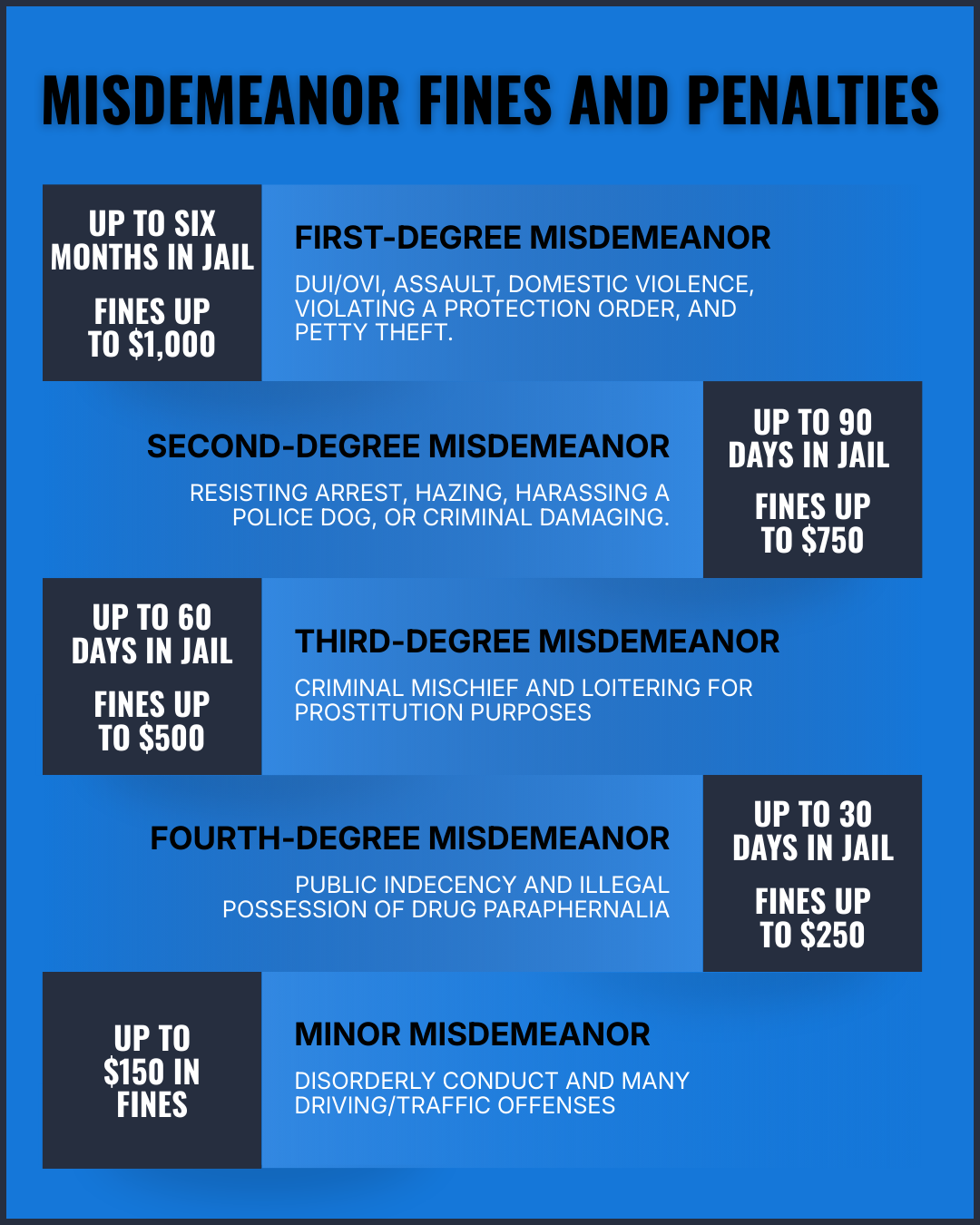
Ohio classifies misdemeanors into five different degrees, or categories:
- First-degree misdemeanor: First-degree misdemeanors are the most serious kind of misdemeanor. They include crimes like DUI/OVI, assault, Domestic Violence, violating a protection order, and petty theft. Generally, first-degree misdemeanors can result in up to six months in jail and fines of up to $1,000.
- Second-degree misdemeanor: Second-degree misdemeanors include crimes like resisting arrest, hazing, harassing a police dog, or criminal damaging. Generally, they’re punishable by up to 90 days in jail and fines of up to $750.
- Third-degree misdemeanor: Third-degree misdemeanors include criminal mischief and loitering for prostitution purposes. The maximum sentence for this category is generally up to 60 days in jail and fines of up to $500.
- Fourth-degree misdemeanor: This type of misdemeanor includes crimes like public indecency and illegal possession of drug paraphernalia. Punishment generally includes up to 30 days of jail time and fines up to $250.
- Minor misdemeanor: Finally, minor misdemeanors, such as disorderly conduct and many driving/traffic offenses, are not punished by jail time. Convicted offenders may pay up to $150 in fines.
Other Penalties for Misdemeanors
Although misdemeanor punishments are minor compared to felonies, convictions can affect your life in other ways. For example, you will have a permanent criminal record. A criminal record can make it difficult to rent a home and get a job. You may not be allowed to possess or own a firearm. Certain offenses, like OVI/DUI and reckless driving, may result in the suspension of your driver’s license. You could also lose any professional licenses you hold. Certain convictions will prohibit you from chaperoning or volunteering at your child’s school activities.
Generally, judges have more discretion when sentencing those convicted of misdemeanors than they do when sentencing those convicted of felonies. Some misdemeanors have mandatory minimum sentences. However, most misdemeanors may be eligible for alternative sentencing. Judges reserve maximum jail time penalties for the worst offenders and probation violators, in most circumstances.
Alternative sentencing options are available for many types of misdemeanors. These can include:
- Intervention in lieu of conviction (ILC): This sentencing alternative is available when the defendant’s mental illness or addictions influence their criminal behavior. The defendant pleads guilty and agrees to intervention services. If they fail to meet their ILC terms, they may be subject to jail time or additional sanctions. If a defendant in ILC successfully completes the terms of a program, the matter is usually dismissed and the record of conviction sealed forever.
- Misdemeanor community control sanctions: Community control sanctions (commonly known as probation or suspended time) allow judges to suspend all or part of a jail sentence. Instead, the defendant may serve time in a halfway house or residential treatment center. They may also order house arrest, community service, and electronic monitoring. Defendants could be subject to curfews and random drug testing, among other measures. Probation / Community control may be unsupervised and non-reporting in the best outcomes.
- Pretrial diversion: Pretrial diversion allows certain defendants the chance to avoid conviction. Like a sort of pre-trial probation, diverted Defendants enter a pretrial diversion program, which may include counseling, supervision, drug testing, and other requirements. If one successfully completes the program, a prosecutor will recommend the charges be dismissed. These outcomes often include sealing of the matter by a Court.
Having an aggressive and persuasive criminal defense attorney on your side increases the likelihood that, if the charges are not dropped, you’ll receive a more favorable and potentially lighter sentencing alternative.
What Kind of Defenses Are Available for Misdemeanor Charges?
Just because you’ve been charged with a misdemeanor doesn’t mean that you’ll be convicted. Always fight. There are many defenses available. A good criminal defense attorney will investigate the individual facts of your case to determine your best defense.
Common misdemeanor defenses include:
- Lack of evidence
- Alibi
- Mistaken identity
- Self-defense
- Statute of limitations issues
- Violation of your Constitutional rights, including illegal searches and seizures, Miranda violations, evidentiary issues, and speedy trial violations.
When you work with McNamee Defense, you’ll receive professional, diligent representation and strategic defense. We’ll pursue every avenue possible to fight for the best outcome for you.
Common Types of Misdemeanor Charges We Defend
McNamee Defense understands the impact a criminal conviction can have on your life. We are committed to providing you with a skillful, compelling defense, regardless of the charges. We never judge. Common misdemeanor charges we defend against include:
- Misdemeanor assault and domestic violence: Simple assault, disorderly conduct
- Misdemeanor drug possession: Marijuana and drug paraphernalia possession
- Misdemeanor DUI/OVI: In Ohio, driving under the influence (DUI) is called Operating a Vehicle Impaired (OVI), Physical Control, Open Container, Driving Under Suspension (DUS).
- Misdemeanor public offenses: Indecent exposure, trespassing, resisting arrest, OOB
- Misdemeanor theft and shoplifting: Petty theft, writing bad checks
- Misdemeanor traffic offenses: Reckless driving, ACDA, No-Ops, Failure to Reinstate
How McNamee Defense Can Help You
If you’ve watched police procedurals on TV, you probably know that every accused person has the right to an attorney (and the right to remain silent). Although public defenders are appointed to those who cannot afford a private attorney, their heavy caseloads make it hard for them to devote their full attention to one client’s needs. There’s too much at stake to leave your representation up to chance.
When you hire McNamee Defense, you’ll receive personalized attention and a custom case strategy. Founding attorney Colin E. McNamee has successfully defended clients since 2011 in State and Federal Courts throughout Ohio. Our firm will use our considerable experience, knowledge, and empathy to work for the best possible resolution in your case.
Throughout the process, we’ll keep you informed and updated about any case developments. We’ll leverage our strong negotiation skills to attempt to reduce or dismiss the charges against you. If the case goes to trial, we’ll aggressively defend your rights.
Our legal assistance doesn’t stop after conviction, either. Depending on the charges and your criminal record, you may be eligible to have your criminal record sealed or expunged. If approved, sealing or expunging your record prevents the public from viewing it. This helps smooth the path to post-conviction employment and housing—a crucial consideration for life after conviction, regardless of the charge.
Finally, we take a discreet approach to your defense. Even misdemeanor charges can be embarrassing and stressful. Our goal is to minimize the disruption to your life while working toward the best and most favorable outcome.
Contact Us for a Free Consultation
Misdemeanors can have lasting consequences. Don’t leave your future up to chance. With McNamee Defense on your side, you can rest assured that you have a passionate and assertive advocate fighting for you. From simple misdemeanors to complex felony cases, we’re ready and able to help.
When you or a loved one need a strong advocate in Columbus, OH, contact McNamee Defense. During your free consultation, we’ll listen to your story and explain the charges against you. We’ll also outline potential defenses and the most likely outcomes.
To schedule your consultation, call us at 614-782-8889 or fill out our contact form today. One mistake shouldn’t ruin your life—let us help you through this challenging time.