
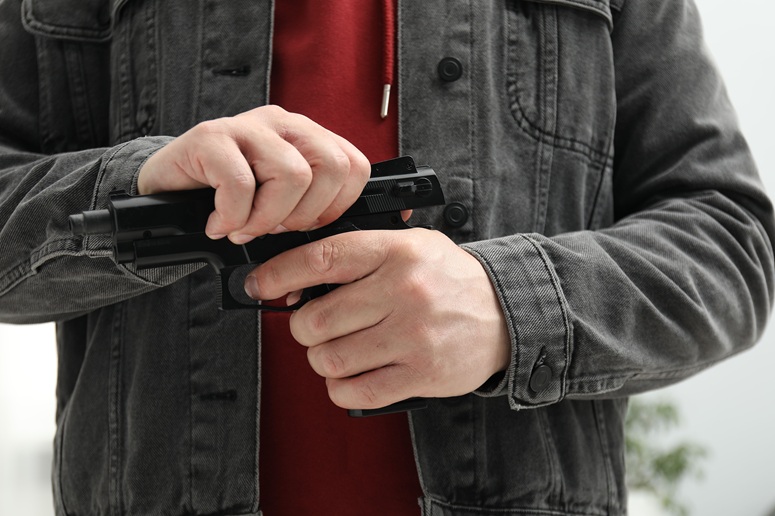
Defending a firearms charge in Ohio begins by identifying the exact charge, evaluating whether the police followed the Constitution during the investigation, and determining whether prosecutors can prove the charge against you. At McNamee Defense, our Columbus criminal defense attorney can craft a defense strategy by carefully reviewing the evidence at every stage of the case to identify opportunities to reduce or dismiss the charges.
The first step in defending any firearm case is determining which Ohio statute applies. Different offenses require prosecutors to prove different legal elements. For instance, Ohio Revised Code § 2923.12 governs carrying concealed weapons, § 2923.13 prohibits having weapons while under disability, and § 2923.16 addresses improperly handling firearms in a motor vehicle. Each offense has its own requirements, defenses, and potential penalties.
Many firearm cases begin with a traffic stop, a search of a vehicle, or the execution of a search warrant. The Fourth Amendment protects people from unreasonable searches and seizures, and evidence obtained in violation of those protections may not be admissible in court. For example, if officers searched your vehicle without probable cause, valid consent, a warrant, or another recognized exception to the warrant requirement, the firearm recovered during that search may become the subject of a motion to suppress.
Finding a firearm does not automatically prove you illegally possessed it. In many cases, prosecutors must prove that you knowingly possessed or controlled the firearm. Acting knowingly is a required mental state for many criminal offenses. For instance, if a handgun is discovered inside a shared vehicle or residence, prosecutors must present evidence showing you exercised control over the firearm, not simply that you were nearby when they found it.
Not all firearms cases are supported by strong evidence. Prosecutors may depend on eyewitness testimony, surveillance footage, social media posts, text messages, or statements made during the investigation. The prosecution must present admissible evidence, and the jury ultimately determines how much weight and credibility to give that evidence. For instance, witnesses may provide conflicting accounts of where the firearm was located, surveillance footage may not clearly identify the person involved, or officers may reach conclusions that are not fully supported by the physical evidence.
Not every firearm charge proceeds to trial. Once the evidence has been thoroughly reviewed, it may become clear that prosecutors have difficulty proving an essential element of the offense or that constitutional issues have weakened their case. Depending on those circumstances, our criminal defense lawyer in Columbus may pursue dismissal of certain evidence, negotiate a reduction of the charges, or continue preparing for trial if litigation offers the strongest path forward.
If your case cannot be resolved beforehand, prosecutors must present admissible evidence proving their case against you. Our legal team will have the opportunity to cross-examine witnesses, challenge the credibility of the state’s evidence, object to improperly admitted testimony, and present evidence supporting your defense when appropriate. Remember that an arrest alone is never enough to obtain a conviction. The prosecution bears the burden of proving its case throughout the trial.
A strong firearm defense strategy is built long before a jury hears the case. Reviewing whether the investigation complied with the Constitution, analyzing the specific statute charged, and identifying weaknesses in the prosecution’s evidence can significantly affect how a case is resolved.
Our Columbus criminal defense attorney can evaluate those issues early, explain your legal options, and develop a defense strategy tailored to the facts of your case. Reach McNamee Defense online or at 614-782-8889 to book your complimentary consultation.